
The Catholic Defender: The Angel's Pardon Prayer
My God, I believe, I adore, I hope and I love You! I beg pardon for those who do not believe, do not adore, do not hope, and do not love You.
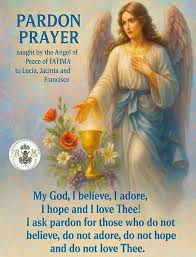
The angel appeared to Lucia, Francisco, and Jacinta three times to prepare them for the later apparitions of Our Lady of Fatima. During the first visit, the angel knelt, bowed to the ground, and had the children repeat those words three times.
It is intended to make amends for those who do not honor God and to practice the theological virtues of faith, hope, and charity.
After teaching it, the angel told the children, "Pray thus. The Hearts of Jesus and Mary are attentive to the voice of your supplications".
Many Catholics recite this prayer during Eucharistic Adoration or as part of the First Saturday devotion.
Begging for pardon or mercy in the Bible is frequently linked to heartfelt repentance, such as when Joseph’s brothers ask for pardon in Genesis 43:20, or the Publican’s plea, "God be merciful to me, the sinner!". Key themes include seeking reconciliation with others (Matthew 5:23-24), and receiving God's grace, as seen in the Prodigal Son story and 1 John 1:9, which promises cleansing from
Joseph’s Brothers (Genesis 43:20): They literally say, "We beg your pardon, our lord" "O sir, we came indeed down at the first time to buy food", expressing fear and seeking mercy.
The Publican (Luke 18:13): In the parable, the tax collector begs for mercy, showing true humility, unlike the Pharisee.
The Prodigal Son (Luke 15:18-19): He prepares to say to his father, "I have sinned against heaven and against you," effectively asking for pardon, and is met with grace.
David (Psalm 51): Following his sin, David desperately pleads for mercy and cleansing, highlighting that God does not despise a broken and contrite heart.
While some argue that Christians need not "beg" because forgiveness is already secured through Jesus (e.g., 1 John 2), the Bible consistently emphasizes a humble, repentant heart (confession) as the posture for receiving that forgiveness (1 John 1:9, 2 Corinthians 7:10).
Reconciliation: Matthew 5:23-24 highlights the importance of seeking forgiveness from people you have wronged.
Seven Times a Day: Luke 17:4 teaches that if someone wrongs you seven times and repents seven times, you should forgive them, illustrating the limitlessness of, and necessity for, mercy.
Parable of the Unforgiving Servant: In a story told by Jesus, a servant who owed an impossible debt fell on his knees and "begged" his master for patience. The master, moved with compassion, canceled the entire debt (Matthew 18:26-27).
Moses' Intercession: In several translations of Numbers 14:19, Moses intercedes for Israel after they rebel, praying, "Pardon, I beg you, the iniquity of this people" (Catholic Public Domain Version) or "Pardon, I pray..." in other versions like the.
Formal Respect: In many Old Testament passages, "begging pardon" (or "beseeching") was a standard way for a subordinate to address a superior or a king to acknowledge a breach of protocol.
Covenant Assurance: Many modern theologians note that while the Bible records individuals begging for mercy, New Testament verses like 1 John 1:9 suggest that confession is the required response to sin, rather than groveling. The emphasis is on God's faithfulness to forgive based on His promise.
Abundant Pardon: The Prophet Isaiah describes God as one who will "abundantly pardon" (Isaiah 55:7), framing pardon not as something extracted through begging, but as a free act of divine grace.


Comments