
The Catholic Defender: Our Lady of the Miraculous Medal Church Approved
Our Lady of the Miraculous Medal is a title of the Virgin Mary based on apparitions to Saint Catherine Labouré in Paris in 1830. During these visions, Mary provided a specific design for a medal, promising that those who wear it with confidence will receive "great graces". Originally called the "Medal of the Immaculate Conception," its name changed after reports of numerous miracles, including healings during a cholera epidemic.
The Apparitions: In 1830, Mary appeared three times to Catherine Labouré, a novice with the Daughters of Charity at the Chapel of Our Lady of the Miraculous Medal on Rue du Bac, Paris.
The Mission: Mary instructed Catherine to have a medal made based on her vision. Catherine kept her identity as the visionary a secret for 46 years.
Rapid Spread: After Church approval in 1832, millions of medals were distributed. By Catherine's death in 1876, the devotion had spread
The front side depicts Mary as the "Mediatrix of All Graces" and the "New Eve".
Mary Standing on the Globe: Represents her role as Queen of Heaven and Earth and her maternal care for the entire world.
Crushing the Serpent: A reference to Genesis 3:15, symbolizing Mary’s victory over Satan and evil through her obedience to God.
Rays of Light: These symbolize the graces Mary obtains for those who ask. During the apparition, Catherine noticed some stones on Mary's rings did not shed light; Mary
The Inscription: "O Mary, conceived without sin, pray for us who have recourse to thee" affirms the Immaculate Conception, the belief that Mary was preserved from original sin from the moment she was conceived.
The Year 1830: Marks the year the design was revealed to Catherine Labouré.
The back of the medal illustrates the inseparable bond between Jesus and Mary in the work of salvation.
Large "M" Intertwined with a Cross: The "M" stands for Mary, and the cross represents Christ's sacrifice. Their interweaving signifies Mary's deep connection to her Son and her role at the foot of the cross.
The Sacred Heart of Jesus (left): Crowned with thorns, representing His infinite love and sacrificial death for humanity.
The Immaculate Heart of Mary (right): Pierced by a sword, recalling Simeon's prophecy (Luke 2:35) about the suffering she would endure as the Mother of the Savior.
Twelve Stars: Referencing Revelation 12:1 ("a woman... with a crown of twelve stars"), these represent the Twelve Apostles and the universal Church.
The medal is intended to be a visible sign of faith and devotion, not a "good luck charm". Mary promised that those who wear it, especially around the neck, with confidence and trust will receive great graces. It was originally called the "Medal of the Immaculate Conception," but earned the name "Miraculous Medal" after countless accounts of healings and conversions were reported by those who wore
The miracles attributed to Our Lady of the Miraculous Medal cover a broad range of physical healings, dramatic spiritual conversions, and miraculous protection. Originally titled the "Medal of the Immaculate Conception," the sacramental was renamed the Miraculous Medal by the public due to the sheer number of wonders that followed its distribution in 1832.
The Conversion of Alphonse Ratisbonne (1842): Perhaps the most famous spiritual miracle, Ratisbonne was a young Jewish man who held a deep hatred for Catholicism. After being dared to wear the medal and recite the Memorare prayer, he received a vision of the Virgin Mary exactly as she appears on the medal. He converted instantly and eventually became a priest.
Miracle of Sight (Belgium, 1836): Rosalie Ducas, a four-and-a-half-year-old girl, suddenly lost her sight in 1835. After her mother placed a blessed medal around her neck and began a novena, the girl stopped experiencing pain within six hours and had her sight completely restored by the ninth day.
The Widow’s Miracle (France, 1834): A 70-year-old impoverished widow who was crippled and unable to walk without assistance after a severe fall began a novena while wearing the medal. By the seventh day, she was completely healed and could walk, climb stairs, and kneel unaided.
Conversion on Death Row (USA, 1943): Claude Newman, an inmate on death row, began wearing a medal discarded by another prisoner. He reported a vision of Mary, which led to his conversion and that of several other inmates. He died in a state of great joy, and his prayers later led to the conversion of a fellow prisoner who had previously mocked religion.
Physical Healings: Numerous reports of recovery from "incurable" conditions, including cholera during the 1832 Paris epidemic, paralysis, and terminal pneumonia.
Spiritual Conversions: Hardened sinners and non-believers frequently reported a sudden "change of heart" or an overwhelming desire to return to faith after receiving or wearing the medal.
Protection from Harm: Accounts include being saved from accidents, surviving life-threatening situations like falls into heavy machinery, and protection during plagues.
Inner Miracles: Many consider the "greatest miracles" to be those of patience, forgiveness, and finding peace during intense suffering.
Despite the miracles associated with the medal, many people don’t believe it can make such a difference. Fr. John A. Hardon, S.J. was one of those people. Not long after he had been ordained, a Vincentian priest encouraged him and others to promote the Miraculous Medal, because Blessed Mother really does work miracles through it. Although Fr. Hardon ordered a free pamphlet on how to bless the medals and enroll people in the Confraternity of the Miraculous Medal, he didn’t get one for himself.
But later, in 1948, when the United States priest encountered a ten-year-old boy who was in a coma after a sledding accident, he decided to see if it would help. A sister who worked at the hospital found one and a ribbon the priest could use to hang it around the boy’s neck.
Even though the boy had been diagnosed with inoperable permanent brain damage, the priest read the prayer that enrolled the boy in the Confraternity of the Miraculous Medal.
As soon as he finished the prayer, the boy opened his eyes and asked his mother for ice cream.
It was the first time he had spoken in nearly two weeks. New x-rays showed the brain damage had disappeared, and the boy was released from the hospital after about three days. Like the boy and his family, the priest’s life and his belief in the medal were forever changed.
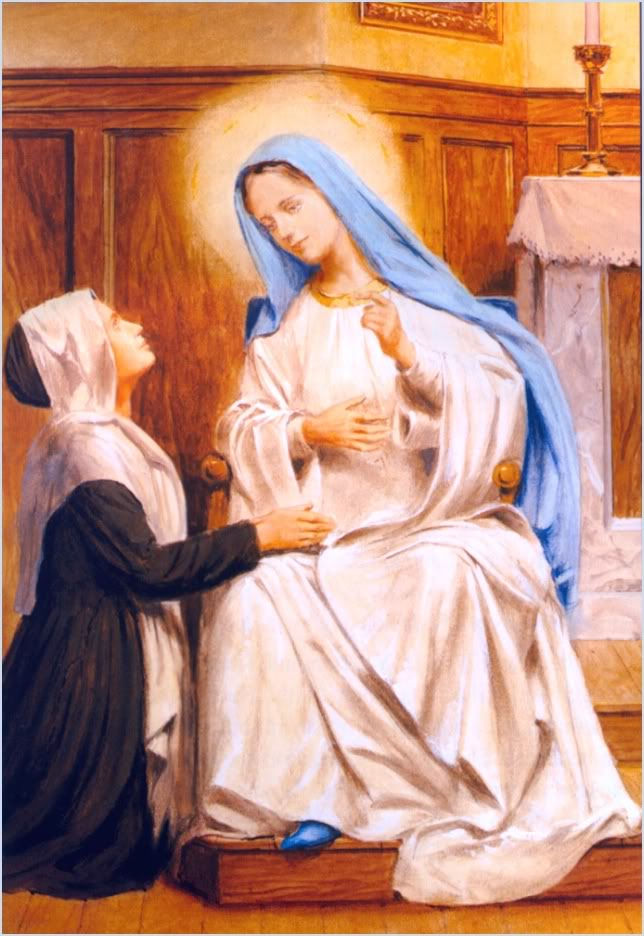
On July 18, 1830 (the eve of the feast of Saint Vincent, at that time) Catherine prayed that, through his intercession, her desire to see the Blessed Virgin Mary would be fulfilled. Previously, at the death of her mother when Catherine was a child, she asked Mary to be her mother.
At eleven-thirty that night, Catherine heard someone call her name.
A mysterious child stood at the foot of her bed and asked her to get up.
“Sister Labouré, come to the chapel.
The Blessed Virgin is waiting for you,” he said. Catherine dressed and followed the child, who was “bringing rays of brightness wherever he passed.”
Having arrived in the chapel, St. Catherine stopped near the priest director’s chair in the sanctuary.
She then heard a sound “like the rustle of a silk dress.”
Her little guide then said, “Here is the Blessed Virgin.” Catherine hesitated. But, the child repeated in a stronger tone of voice, “Here is the Blessed Virgin.”
Catherine rushed to the chair and knelt at the feet of the Blessed Virgin, who was seated on the chair, and Catherine rested her hands on the knees of the Mother of God.
“There, a period of time passed, the sweetest of my life.
It would be impossible for me to say what I experienced.
The Blessed Virgin told me how I should behave towards my spiritual director and also several other things.”
The Blessed Virgin pointed to the altar where the tabernacle was and said, “Come to the foot of this altar. Here, graces will be given to all who ask for them with confidence and fervor.”
Catherine’s new mission was to spread this promise of God and Mary to the world.
Also, Mary asked for the establishment of a Confraternity of the Children of Mary. Catherine’s confessor, Father John Mary Aladel, C.M., would accomplish this request on February 2, 1840.
The apparitions of Our Lady of the Miraculous Medal to Saint Catherine Labouré were formally approved by the Catholic Church in 1836.


Comments