
The Catholic Defender: "I will give you the keys to the kingdom of Heaven. Whatever you bind on earth shall be bound in Heaven"
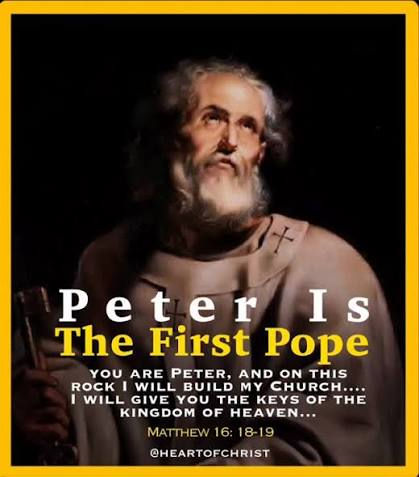
and whatever you loose on earth shall be loosed in heaven", Gospel of Matthew (Matthew 16:19), spoken by Jesus Christ to the Apostle Peter. It represents one of the most foundational and debated passages in the New Testament regarding spiritual authority and the structure of the Catholic Church.
Compare withthe keys given to St. Peter with "the keys of the house of David will I lay upon his shoulder; so he shall open, and none shall shut; and he shall shut, and none shall open".
Historical and Literal Meaning
In the original historical context, God says this about Eliakim, who replaces the arrogant royal official Shebna as master of the palace under King Hezekiah.
Symbol of Authority: Placing a large key on the shoulder was an ancient literal and symbolic action. It represented carrying the heavy weight of administrative power, supreme stewardship, and complete control over who could enter the royal presence or access the royal storehouses
The Key of David: Christians view Eliakim as a temporary picture or "type" pointing forward to Jesus Christ.
Revelation 3:7: The Book of Revelation applies this exact phrase to Jesus, describing Him as the ultimate holder of the Key of David who opens doors no human can shut.
Absolute Sovereign Power: It highlights Christ's supreme authority over salvation, heaven, spiritual realms, and historical events
The statement occurs during a pivotal moment known as the Confession of Peter at Caesarea Philippi. Jesus asks His disciples, "Who do you say that I am?" Peter famously responds, "You are the Messiah, the Son of the living God." In response to this revelation, Jesus changes Simon's name to Peter (meaning "Rock") and proclaims:
"And I tell you that you are Peter, and on this rock I will build my church, and the gates of Hades will not overcome it. I will give you the keys of the kingdom of heaven; whatever you bind on earth will be bound in heaven, and whatever you loose on earth will be loosed in heaven."
What Do the "Keys" and "Binding/Loosing" Mean?
In ancient times, giving someone the "keys" meant granting them stewardship or administrative authority over a household or kingdom. In a biblical context, theologians generally agree on two main aspects:
The Keys: Represent spiritual authority and the power to open the door of salvation (the Gospel) to the world.
Binding and Loosing: These were traditional rabbinic terms. To "bind" meant to forbid or declare something unlawful, and to "loose" meant to permit or declare something lawful. It implies the authority to make binding decisions regarding doctrine, ethical behavior, and fellowship within the community.
Exploring both of these passages unveils a profound connection regarding structural authority, stewardship, and the biblical imagery of leadership.
The structural parallel between Isaiah 22 and Matthew 16:19 provides crucial background for understanding what Jesus meant by giving the "keys of the kingdom."
1. The Old Testament Blueprint: Isaiah 22 and Shebna's Fall
In the ancient Near East, the "Master of the Palace" (al-habbayit) acted as a royal steward or prime minister, holding administrative authority over the kingdom just below the king
The Demotion of Shebna: Shebna was a high-ranking official under King Hezekiah. However, because of his pride and self-serving nature, God declared through the prophet Isaiah that Shebna would be stripped of his position.
The Transfer of the Key: God replaced Shebna with Eliakim. In Isaiah 22:22, God states: "I will place on his shoulder the key to the house of David; what he opens no one can shut, and what he shuts no one can open." The physical, oversized ceremonial key represented absolute delegated authority to regulate entry and manage the king's household.
2. The New Testament Fulfillment: Matthew 16:19
When Jesus takes His disciples to Caesarea Philippi in Matthew 16, He uses language that directly echoes the office of the royal steward. After Simon confesses that Jesus is the Christ, Jesus renames him Peter and says:
"I will give you the keys of the kingdom of heaven; whatever you bind on earth will be bound in heaven, and whatever you loose on earth will be loosed in heaven."
By invoking the "keys" and the authority to open/shut (conceptualized here as binding and loosing), Jesus positions Himself as the true Davidic King. He appoints Peter as His chief steward—His prime minister—to govern the Church on earth while the King is away.
This parallel forms a primary theological foundation for the papacy. The transfer of the keys to Peter is viewed as the institution of a permanent office of supreme leadership, meant to be passed down through apostolic successio
The Rock and the Keys: In Matthew 16:18-19, Jesus tells Simon, renamed Peter (meaning "Rock"), that He will build His church on him and gives him the keys to the kingdom of heaven with the power to bind and loose.
This imagery reflects the Old Testament role of the master of the palace or royal steward (seen in Isaiah 22:19-22), who held supreme administrative authority in the king's absence.
In John 21:15-17, Jesus commands Peter to feed His lambs and tend His sheep, establishing him as the shepherd of the universal flock.
How apostolic succession is explained in early Christian writings
In early Christian writings, apostolic succession is explained as a deliberate mechanism to preserve orthodox doctrine, safeguard church governance, and counter heretical groups. Rather than a hidden or private transmission of knowledge, early church fathers described it as a public, verifiable line of bishops extending directly back to Jesus's apostles.
The concept evolved across the first few centuries, serving primarily as a benchmark for teaching and unity
1. Order and Appointment: Clement of Rome (c. 80–96 AD)
How apostolic succession is explained in early Christian writings
Writing to the church in Corinth, Clement of Rome provided the earliest explicit explanation of why succession was established. He framed it as an orderly arrangement initiated by Christ to prevent future disputes over leadership.
"Our Apostles knew through our Lord Jesus Christ that there would be strife for the office of bishop..."
2. Guarding the Truth: Irenaeus of Lyons (c. 180 AD)
In Against Heresies, Irenaeus of Lyons presented succession as the ultimate test against Gnostic secret traditions. He emphasized a public lineage, the "charism of truth" given to bishops, and demonstrated historical continuity by listing the unbroken line of the Bishops of Rome.
3. Challenging Heretics: Tertullian (c. 200 AD)
In The Prescription Against Heretics, Tertullian challenged unorthodox groups to produce historical episcopal records tracing back to the apostles (full text can be found in the source documents). He maintained that a church sharing apostolic doctrine was considered "apostolic" regardless.
Apostolic Fathers (e.g., Clement): Focused on orderly office and preventing strife to preserve community peace.
Apologists (e.g., Irenaeus, Tertullian): Used traceable lines of bishops to counter secret claims and safeguard the Gospel.
Later Fathers (e.g., Cyprian, Augustine): Emphasized sacramental grace and corporate unity.


Comments