
The Catholic Defender: The Catholic Church during the Northwest Indian War (1785–1795)

During the Northwest Indian War (1785–1795), the Catholic Church operated as a faint institutional presence in the Northwest Territory. The region was caught in a transition between its French colonial past, Native American alliances, and a rapidly expanding United States.
Rather than acting as an organized political force or deploying massive mission networks, the Church’s involvement was limited to a few isolated French parishes, traveling missionaries, and the shifting loyalties of Catholic-influenced Native Americans. [
A Church in Institutional Transition
Before the war, the Northwest Territory had been heavily influenced by French Jesuit missionaries. However, the defeat of France in 1763 and the subsequent passage of the Northwest Ordinance of 1787 placed the region under American control.
The Carroll Jurisdiction: In 1789, John Carroll was consecrated as the first Catholic bishop of the United States. He inherited a vast, war-torn frontier with almost no priests to spare.
The French Enclaves: Organized Catholic life was restricted to older French-Canadian fur-trading posts like Detroit (Ste. Anne's Church), Vincennes (Indiana), Kaskaskia, and Cahokia (Illinois). These communities were frequently suspected of harboring British or Native sympathies.
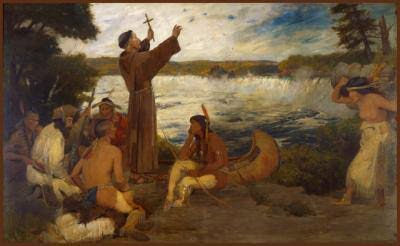
Religious Freedom: The Northwest Ordinance of 1787 guaranteed religious toleration, legally protecting Catholics from Protestant discrimination, which paved the way for later 19th-century immigrant settlement.
The Northwest Indian Confederation was a union of primarily Algonquian-speaking peoples who resisted American expansion into the Northwest Territory after the American Revolution. Key tribes included the Shawnee, Delaware, Ottawa, Ojibwa, Miami, and Potawatomi.
Led by Miami chief Little Turtle, the confederation achieved significant victories against U.S. forces in 1790 and 1791.
However, after a decisive defeat at the Battle of Fallen Timbers in 1794 and the loss of British support, the confederation was forced to cede vast territories in the Treaty of Greenville in 1795.
Native Alignment and the Catholic Identity
The conflict pitted the Western Confederacy—a coalition of Native American tribes including the Miami, Shawnee, and Delaware—against the United States.
Socio-Religious Blending: Decades of interaction with French "Blackrobes" (Jesuits) meant that segments of tribes like the Miami, Potawatomi, and Ottawa carried Catholic devotion, baptismal records, and French names
The British Factor: The British military illegally retained forts in the territory, supplying Native forces. Because Canada was heavily Catholic (strengthened by the British Quebec Act of 1774), Native warriors often viewed Catholic symbols and French traders as friendlier than the fiercely anti-Catholic, land-hungry American pioneers.
Tribal Resistance: Religious identity did not soften the fighting. Native groups fought fiercely to defend their ancestral lands against American expansion.
The Aftermath: The 1795 Treaty of Greenville
The war effectively ended following General Anthony Wayne's victory at the Battle of Fallen Timbers (1794), culminating in the signing of the Treaty of Greenville on August 3, 1795.
Land Cessions: The treaty forced Native tribes to cede most of present-day Ohio, along with strategic pieces of Indiana and Michigan, to the U.S. government.
Indigenous Endowments: Reflecting the long-standing trust between specific tribes and the Church, subsequent provisions and land iterations—such as those involving the Anishinaabeg and Miami—often set aside specific tracts of land for the use of the Catholic Church or frontier education (such as allocations directly to St. Anne of Detroit).
Settlement Surge: The stabilization of the frontier allowed Bishop Carroll to systematically send the first waves of Dominican and Sulpician missionaries to build log churches, turning the war-torn frontier into a permanent fixture of American Catholicism.
Indigenous leaders across the Americas engaged with Catholic missionaries through diplomacy, religious conversion, or armed resistance. Because European colonization relied heavily on the Catholic Church to govern the spiritual and social lives of Native communities, these interactions permanently reshaped regional politics, cultural traditions, and tribal survival.
The profiles below highlight several prominent Native leaders, their specific tribes, and the nature of their interactions with Franciscan, Jesuit, and secular Catholic priests.
Diplomacy and Mediation
Sitting Bull (Húnkpapȟa Lakota): The iconic holy man and tribal leader famously interacted with Belgian-born Jesuit priest Father Pierre-Jean De Smet. Known to tribes as the "Black Robe," De Smet built deep rapport with the Lakota over decades. In June 1868, the U.S. government utilized De Smet as an intermediary to negotiate an end to the Sioux War. Sitting Bull personally protected De Smet in his camp, which directly paved the way for the historic 1868 Treaty of Fort Laramie.
Chief Victor (Lower Kalispel) & Chief Alexander (Upper Kalispel): These Pacific Northwest leaders worked extensively with Father De Smet to navigate tribal territorial conflicts and colonial expansion. They eventually collaborated directly with the Jesuit missionary to establish the St. Ignatius Mission in the Columbia River region.
Strategic Conversion and Adaptation
Leopold Pokagon (Potawatomi): As head of the Pokagon Band of Potawatomi in the Great Lakes region, Pokagon proactively traveled to Detroit in 1830 to request a permanent Catholic priest for his village. His alliance with French Jesuit missionaries led to widespread tribal baptism. This strategic embrace of Catholicism was utilized by Pokagon as a legal and cultural defense mechanism, ultimately helping his band avoid forced federal removal west under the Indian Removal Act.
Nicholas Black Elk (Oglala Lakota): A revered medicine man who survived the Battle of the Little Bighorn and the Wounded Knee Massacre, Black Elk converted to Catholicism in 1904. Working closely with Jesuit missionaries, he spent decades serving as a catechist, baptizing hundreds of Native Americans and bridging Lakota spirituality with Catholic theology. He is currently on the path to sainthood within the Catholic Church
Kateri Tekakwitha (Algonquin-Mohawk): Born in a Mohawk village, she interacted with French Jesuit missionaries who were permitted into Mohawk territory following a series of military conflicts. Defying immense pressure from her family and traditional peers, she converted to Catholicism and later relocated to Kahnawake, an Indigenous Catholic settlement in Quebec. In 2012, she was canonized as the first Native American Saint in the United States.
Resistance and Conflict
Po'pay (Ohkay Owingeh / San Juan Pueblo): Following decades of aggressive, enforced suppression of traditional Indigenous spirituality by Spanish Franciscan friars in New Mexico, Po'pay emerged as a powerful religious and military leader. He successfully organized the Pueblo Revolt of 1680, a coordinated uprising that killed over 20 Franciscan missionaries, drove the Spanish out of Santa Fe, and temporarily restored ancestral Pueblo religious autonomy.
The Caciques of La Florida (Calusa and Timucua): In the 16th and 17th centuries, regional tribal chiefs across the Southeast frequently resisted Spanish mission reductions. Early Jesuit attempts to proselytize the Calusa tribe in southern Florida under Father Juan Rogel were aggressively rebuffed by tribal leaders, forcing the missions to abandon the region due to ongoing hostility and tactical non-cooperation.


Comments