
The Catholic Defender: The Catholic Church during the Civil War

During the American Civil War, the Roman Catholic Church did not officially split along regional lines, unlike major Protestant denominations (such as the Methodists and Baptists). However, individual Catholics overwhelmingly aligned with the region in which they lived, fighting for both the Union and the Confederacy.
At the outbreak of the war, Catholics made up roughly 10 percent of the U.S. population (around 3 million people), heavily concentrated in Northern urban centers due to Irish and German immigration. Despite historical anti-Catholic sentiment, the war served as a major turning point for Catholics to prove their patriotism and integrate into mainstream American life.
The Position of the Bishops and the Slavery Debate
A Divided Hierarchy: While the Vatican historically opposed the slave trade, U.S. bishops were deeply divided over the institution of slavery and individual states' rights.
Northern Leadership: High-profile leaders like Archbishop John Hughes of New York strongly supported the Union. President Abraham Lincoln even dispatched Archbishop Hughes to Europe as a diplomatic envoy to secure European neutrality.
Southern Leadership: In the South, bishops like Jean-Marie Odin of New Orleans and Patrick Lynch of Charleston backed the Confederacy. Bishop Lynch vocally supported South Carolina’s secession and was sent by Confederate President Jefferson Davis to Europe to lobby for the Confederacy's recognition.
Catholics on the Battlefield

Soldiers: Approximately 200,000 Catholics fought in the war. The vast majority fought for the Union—including the famous, predominantly Irish-Catholic "Irish Brigade"—but thousands of Southern Catholics also joined the Confederate ranks.
Generals: Prominent Catholic officers rose to high ranks on both sides. Notable Union generals included Philip Sheridan and William Rosecrans, while the Confederacy claimed generals like James Longstreet (who converted after the war) and William Hardee.
Chaplains: Around 80 to 120 Catholic priests served as military chaplains. Priests like Father William Corby became famous for giving general absolution to troops on the battlefield, most notably to the Irish Brigade at the Battle of Gettysburg.

Nuns as Battlefield Nurses, Angels of the Battlefield: Catholic Sisters as Civil War Nurses
'They comforted the dying. Nursed the wounded. Carried hope to the imprisoned. Gave in his name a drink of water to the thirsty."-Inscription on the Nuns of the Battlefield Monument, Washington, D.C.
When civil war divided the United States, among those answering the call to serve were nearly 600 Roman Catholic sisters, many of them new residents of the young nation.
War broke out before governments on both sides made detailed arrangements for hospitals and medical care for their soldiers.
Among some of the sisterhoods who brought their nursing skills to their new communities in the United States were the Sisters of Mercy.
"The Sisters of Mercy fulfilled a very important role with the military on both sides during the Civil War because there were very few trained nurses in those days," said Myra Joines with the Sisters of Mercy of the Americas.
Some of the European sisters learned nursing skills while serving in the Crimean War alongside nursing pioneer Florence Nightingale. For centuries in Europe, members of religious communities visited the sick in their homes. American communities established as many as 28 hospitals in the United States before war broke out.
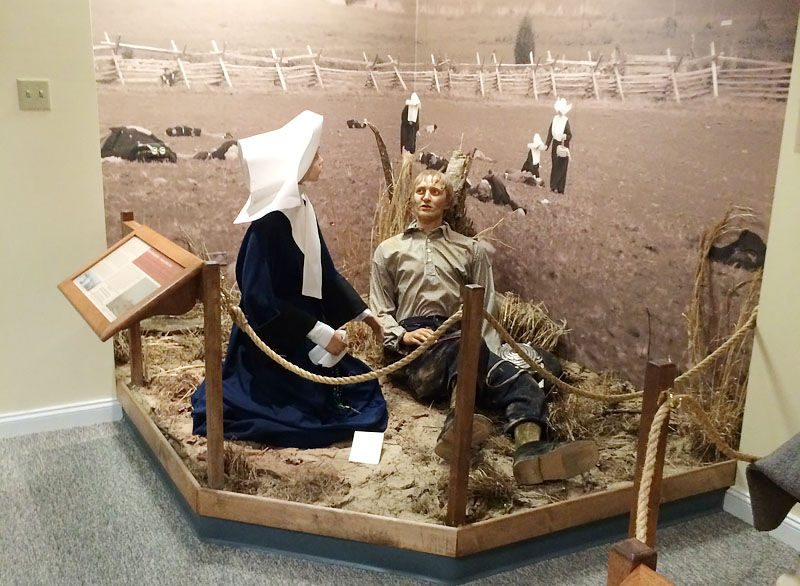
"One of the focuses of the Sisters of Mercy since their inception in Ireland was to care for the sick," said Joines.
Officials from both the Union and the Confederacy were hesitant to use female nurses, but they, including President Abraham Lincoln, requested help from the Catholic sisterhoods. In the South, it was considered inappropriate for women to be involved in the physical contact that nursing duties required.
About 9,000 secular women nursed for the Union Army. The Confederacy recorded the service of about 1,000 women. The catholic sisters served soldiers from both sides, many times under the same hospital roof.
"They simply did what was needed and without complaint," said Joines. "And they didn't ask for very much in return. Their needs were very basic. They worked extremely hard and extremely long hours and did whatever it took, whereas women from other walks of life, first of all, were not used to that type of discipline, those types of demands."
When diseases such as smallpox broke out, even doctors refused to help patients. Some sisters sacrificed their lives to nurse soldiers suffering from contagious diseases. Others died from exhaustion.
Sisters of Charity from Cincinnati were among the first medical teams to arrive by steamboat at the battle of Shiloh. The first U.S. Navy hospital ship, Red Rover, was staffed by Sisters of the Holy Cross from Notre Dame, Indiana as the first Navy nurses. Two days after the Battle of Gettysburg, the Daughters of Charity of Emmitsburg, Maryland traveled the 20 miles from their motherhouse to the battlefield to serve the wounded. Throughout the war, they asked for nothing other than food and supplies to help the soldiers.
Sisters of Charity of Our Lady of Mercy in Charleston, South Carolina, were sent to Greenbrier White Sulphur Springs, Virginia, to manage a hospital there. Those left behind visited soldiers held as prisoners-of-war. After the war, the Charleston sisters returned home to find their Queen Street convent and school destroyed.

The sisters' war experience led to breakthroughs and innovations in medicine.
"The sisters learned a great deal on the battlefield," said Joines. "One of the things they picked up from nursing the wounded as well as nursing the economically poor was the importance of cleanliness, and that so often what killed people was not so much the wound, but infection from unsanitary conditions."
They also established new roles for women in America's changing society.
"Sister Mary Collette O'Connor, who was Superintendent of Douglas Military Hospital in Washington, D.C. and apparently was not only an extraordinary nurse, but an extraordinary administrator at a time when you didn't find women in those roles," said Joines. "She was so honored by the military that they gave her the rank of Major in gratitude for what she had done on behalf of the soldiers."
Although the nation's Irish population was familiar with the works of the Catholic sisterhoods in the mid-19th century, they were sometimes the victims of anti-Catholic prejudice. The sisters' service to the sick, wounded and dead, no matter their race, religion, socioeconomic status, ethnicity, or the uniform they wore, helped alleviate some of the prejudice that victimized them.

"It was very unpleasant for a number of Catholics in this country," said Joines. "But because of the compassion they showed to the soldiers, whether the soldiers were Catholic, Protestant, Jewish, had any religious affiliation, that touched the hearts of a lot of those men, as well as the hearts of their families."
"When the ministries were established in the 1800's, no one was doing that kind of work," Joines said. "So it was extraordinary for anyone to do it. It was unbelievable pioneering for women to do it."
After the war, the surviving sisters returned to their communities. Some continued nursing in hospitals, some returned to teaching, some headed west to establish new communities, and some cared for the widows and orphans of the soldiers they nursed.
"To Bind Up the Wounds", Catholic Sister Nurses in the U.S. Civil War by Sister Mary Denis Maher was used as a resource for this story.
Image: John Hauser's copy of painting, "Consolation," commissioned by Abraham Lincoln to Florence Meyer (Source: Myra Joines)
One of the most widely respected Catholic contributions came from women religious. Over 600 Catholic nuns from various orders (such as the Sisters of Charity and Sisters of the Holy Cross) volunteered as battlefield nurses. They treated wounded soldiers on both sides without pay. Because Protestant-dominated military hospitals lacked an organized nursing corps at the start of the war, the structured, disciplined assistance of these sisters radically reduced anti-Catholic prejudice among veterans.
Political Strains and the Draft Riots
Despite widespread military service, Northern Catholics (who predominantly aligned with the Democratic Party) grew weary of the war by 1863. Many were skeptical of Lincoln's emancipation policies, fearing that free Black laborers would compete for low-wage Northern jobs and that aggressive Republican abolitionists would eventually target Catholic institutions next. This resentment culminated in the 1863 New York City Draft Riots, where working-class Irish-Catholics violently revolted against the military draft, requiring Catholic priests and leaders to take to the streets to restore order.
The Vatican's Stance
Pope Pius IX maintained official neutrality throughout the conflict. While he exchanged courteous correspondence with Jefferson Davis addressing him as the "Honorable President of the Confederate States of America," the Vatican never formally recognized the Confederacy as an independent nation, despite Southern propaganda attempts to claim otherwise.


Comments