
The Catholic Defender: Good Friday, The Paschal Triduum

Good Friday is a solemn Christian holy day that commemorates the crucifixion of Jesus Christ and his death at Calvary. Observed during Holy Week, it is a day of deep reflection, penance, and fasting.
The date of Good Friday changes every year to coincide with the Friday before Easter Sunday.
The term "Good" in Good Friday may seem paradoxical given the suffering it marks, but it is used for several historical and theological reasons
In Old English, "good" was synonymous with "holy". It likely referred to the day as "Holy Friday."
Christians call it "good" because they believe Jesus' sacrifice led to the "good news" of salvation and the redemption of humanity.
Many churches hold special liturgies between noon and 3:00 PM, the hours Jesus is traditionally believed to have hung on the cross.
A common ritual where worshippers approach and touch or kiss a crucifix as a sign of reverence.
A 14-step devotional practice that retraces the final steps of Jesus leading to his burial.
Many Christians, particularly Catholics, observe a strict fast and abstain from eating meat.
In many cultures, believers hold "Way of the Cross" processions, often featuring life-sized statues or dramatic re-enactments of the Passion.
The term "Good" in Good Friday may seem paradoxical given the suffering it marks, but it is used for several historical and theological reasons
Holy Friday, Great Friday, Great and Holy Friday, or Friday of the Passion of the Lord
is a solemn Christian holy day commemorating the crucifixion of Jesus and his death at Calvary (Golgotha). It is observed during Holy Week as part of the Paschal Triduum.

The Paschal Triduum (Latin for "Three Days") is the most sacred period of the Christian liturgical year, commemorating the Passion, Death, and Resurrection of Jesus Christ. While it spans three calendar days, it is liturgically considered one single celebration that unfolds the unity of the "Paschal Mystery".
The Triduum follows the ancient Jewish tradition of counting a day from sunset to sunset
Holy Thursday: Begins with the Mass of the Lord's Supper, commemorating the institution of the Eucharist and the Priesthood. It often includes the ritual washing of feet to symbolize Christ's call to service. Washing of Feet, Institution of Eucharist
Good Friday: A day of fasting and penance focused on the Passion and Crucifixion. This is the only day of the year when Mass is not celebrated; instead, a "Liturgy of the Lord’s Passion" takes place. Veneration of the Cross, No Mass
Holy Saturday & Easter Sunday: Reaches its "summit" during the Easter Vigil on Saturday night—a dramatic service beginning in darkness that celebrates the Resurrection. The Triduum officially concludes with Evening Prayer (Vespers) on Easter Sunday. Blessing of Fire, Baptism of new members
A Continuous Liturgy: Because the Triduum is one event, there is often no "Final Blessing" at the end of Holy Thursday or Good Friday; the blessing is only given at the end of the Easter Vigil.
Liturgical Colors: Priests wear White on Holy Thursday (celebration) and the Easter Vigil (joy), and Red on Good Friday (martyrdom/suffering).
A new candle is lit from a "new fire" during the Easter Vigil, representing Christ as the Light of the World.
The candle you are describing is the Paschal candle (or Easter candle), which is a central symbol of the resurrected Christ in Western Christian liturgies, including Roman Catholic, Anglican, and Lutheran traditions.
At the beginning of the Easter Vigil service on Holy Saturday, all lights in the church are extinguished to represent a world in darkness.
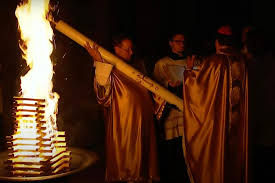
Kindling the Fire: A "new fire" is kindled, often outside the church, symbolizing the light of Christ rising from the tomb.
Lighting the Candle: The priest blesses this fire and uses it to light the Paschal candle, praying that the "light of Christ's rising glory" dispels the darkness.
The candle is carried into the dark church. As it passes, the faithful light their own small tapers from its flame, symbolizing the spreading of Christ's light throughout the world.
The Cross: The central symbol of the redemption.
Alpha and Omega: The first and last letters of the Greek alphabet, signifying that Christ is the beginning and the end.
The Current Year: A reminder that God is the author of all time and is present in the "here and now".
Five Grains of Incense: Often shaped like red nails, these are inserted into the candle to represent the five wounds of Jesus.
After Easter, the candle remains lit for all services until Pentecost. It is then moved near the baptismal font and is lit for every baptism and funeral to signify the promise of resurrection and new life.
between 4 April and 8 May in terms of the Gregorian calendar, during the period 1900 and 2099), so Good Friday can fall between 20 March and 23 April
In the 1955 reform of Holy Week, it was renamed Feria sexta in Passione et Morte Domini ("Friday of the Passion and Death of the Lord"), and in the new rite introduced in 1970, shortened to Feria sexta in Passione Domini ("Friday of the Passion of the Lord")
The Catholic Church regards Good Friday and Holy Saturday as the Paschal fast,
The Roman Rite has no celebration of Mass between the Mass of the Lord's Supper on Holy Thursday (Maundy Thursday) evening and the Easter Vigil unless a special exemption is granted for rare solemn or grave occasions by the Vatican or the local bishop. The only sacraments celebrated during this time are Baptism (for those in danger of death), Penance, and Anointing of the Sick.[63] While there is no celebration of the Eucharist, it is distributed to the faithful only in the Celebration of the Passion of the Lord, but can also be taken at any hour to the sick who are unable to attend this celebration.
According to the accounts in the Gospels, the royal soldiers, guided by Jesus' disciple Judas Iscariot, arrested Jesus in the Garden of Gethsemane. Judas received money (30 pieces of silver) [17] for betraying Jesus and told the guards that whomever he kisses is the one they are to arrest. Following his arrest, Jesus was taken to the house of Annas, the father-in-law of the high priest, Caiaphas. There he was interrogated with little result and sent bound to Caiaphas the high priest where the Sanhedrin had assembled.


Comments