
The Catholic Defender: The Apostles Creed.

I believe in God, the Father Almighty,
To believe means to accept something as true, real, or valid, often based on conviction, trust, or faith rather than absolute proof. It involves a mental acceptance of a concept, statement, or the existence of something, such as in religious faith, trusting a person, or holding a personal opinion.
Conviction that a claim is accurate, such as believing a report or theory.
Placing confidence in someone or something, often in religious or personal contexts.
Holding a conviction without firsthand evidence, such as believing a story
.
In many contexts, belief shapes behavior and acts as a reliance upon a person or idea.
Beliefs can be held with varying degrees of confidence and can sometimes exist despite contradictory evidence.
Accepting a statement or proposition as a fact (e.g., "I believe it will rain").
Having faith in someone’s reliability or ability (e.g., "I believe in you").
Being sure that something exists (e.g., "I believe in ghosts").
Being in favor of an idea because you think it is right (e.g., "I believe in democracy").
Philosophy often defines belief as a "working assumption" held without direct first-hand evidence. While knowledge requires proof, belief is a subjective state of being convinced.
Philosophers like Charles Peirce describe belief as a "rule of action" or a habit that guides how you behave.
Often translated as "to trust" or "to entrust one's life to". It implies a total reliance rather than just acknowledging facts.
Historically, the root of "believe" is linked to "love" and "fidelity" (Old English belyfan), meaning to hold something dear or valuable.
Some differentiate the two by saying belief is the preliminary step of acceptance, while faith is the active personal transformation that follows.
The Father Almighty

is the opening declaration of the Apostles' Creed and Nicene Creed, identifying God as both tender Creator (Father) and omnipotent ruler (Almig
Represents God's intimacy, tenderness, and relational natureignifies omnipotence, authority, and the ability to do all things.
It affirms trust in God’s ability to protect and provide in all circumstances.
Derived from the Hebrew El Shaddai, it signifies God's absolute sovereignty, unlimited power, and authority over all creation.
He is recognized as the source of the Godhead and the Creator of heaven and earth.
The creeds present a God who is both close enough to be called "Father" (Abba) and powerful enough to sustain the entire universe.
Creator of heaven and earth,

God is the creator of heaven and earth, as stated in Genesis 1:1, "In the beginning God created the heavens and the earth".
God created through divine word (e.g., "Let there be light").
The initial state was formless and void, with the Spirit of God moving over the waters.
Creation involved separating light from darkness, forming the sky, land, seas, and76 creating life over a series of days.
Genesis 1:1: "In the beginning, God created the heavens and the earth".
Psalm 146:6: "He is the Maker of heaven and earth, the sea, and everything in them—he remains faithful forever".
Acts 17:24: "The God who made the world and everything in it is the Lord of heaven and earth".
and in Jesus Christ, His only Son, our Lord,

a foundational statement of Christian belief. It transitions from the confession of God the Father to the person and work of Jesus Christ
"...who was conceived by the Holy Spirit, born of the Virgin Mary".
"...suffered under Pontius Pilate, was crucified, died and was buried".
"...He descended into hell; on the third day He rose again from the dead".
"...He ascended into heaven, and is seated at the right hand of God the Father almighty".
"...from there He will come to judge the living and the dead".
Jesus: His proper name, signifying His humanity and His role as Savior ("God saves").
Christ: Not a surname but a title (from the Greek Christos and Hebrew Messiah), meaning the "Anointed One".
His Only Son: Affirms Jesus’ unique, divine relationship with God the Father and His nature as the second person of the Trinity.
Our Lord: Declares His absolute authority and sovereignty over the lives of believers.
who was conceived by the Holy Spirit,
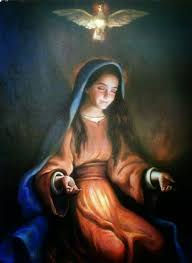
According to Christian theology, the Bible (Matthew 1:18-25, Luke 1:26-38), and the Apostles' Creed, Jesus Christ was conceived by the Holy Spirit and born of the Virgin Mary. This miraculous conception signifies that Jesus is the Son of God, fully divine and fully human, rather than the product of natural human procreation.
The Holy Spirit caused the Virgin Mary to conceive, as announced by the angel Gabriel.
This supernatural conception allowed Jesus to be born without a sinful nature, enabling him to be the sinless Savior.
It highlights the incarnation—God becoming human—and establishes Jesus' identity as both the Son of God and the son of Mary.
While the Holy Spirit acted as the agent of conception, Mary provided the human element.
This event, known as the Virgin Birth or the Incarnation, is a foundational tenet of the faith, described in the Gospels of Matthew and Luke.
The Holy Spirit (also referred to as the Power of the Most High) "overshadowed" Mary to cause the conception without a human father.
Human Mother: Mary, a virgin betrothed to Joseph, was chosen as the vessel to bring Jesus into the world.
This miraculous beginning is believed to ensure that Jesus was born without original sin, allowing Him to be both fully God and fully man.
The phrase "conceived by the Holy Spirit" is a central line in the Apostles' Creed and the Nicene Creed, which summarize core Christian beliefs.
John the Baptist : Described in Luke 1:15 as being filled with the Holy Spirit even from his mother's womb.
Isaac : Referred to by St. Paul inGalatians 4:29 as "born according to the Spirit" because his birth to elderly parents was a miracle of God's promise.
born of the Virgin Mary,

Mary is a foundational Christian doctrine, affirmed in the Apostles' Creed, stating Jesus Christ was conceived by the Holy Spirit and born to Mary while she was a virgin. This miraculous event signifies Jesus as both fully divine (Son of God) and fully human, born without original sin.
Recorded in the Gospels of Matthew (1:20) and Luke (1:27, 34), which detail the conception through the Holy Spirit.
It highlights the supernatural nature of Christ's incarnation and is essential to the Christian understanding of salvation.
It signifies that Jesus is both fully God and fully man (the "God-man").
This doctrine is distinct from the Catholic tenets of the Immaculate Conception (Mary being conceived without sin) and Perpetual Virginity
It is viewed as the fulfillment of the Old Testament prophecy in Isaiah 7:14, where a virgin would conceive and bear a son named Immanuel.
While the birth of Jesus from Mary is central, the Church also celebrates the birth of Mary herself, traditionally recognized on September 8, nine months after the Feast of the Immaculate Conception. According to tradition, her parents were Saints Joachim and Anne.
.
Suffered under Pontius Pilate

"Suffered under Pontius Pilate" is a phrase from the Apostles' Creed highlighting that Jesus' suffering, crucifixion, and death were historical events, not myths. It grounds the Christian faith in specific time and place, acknowledging that Jesus was sentenced to death by the Roman prefect of Judea, Pontius Pilate, despite his recognized innocence.
Pontius Pilate was the Roman governor (prefect) of Judea from 26/27 to 36/37 AD, appointed to maintain order, and known for being harsh.
Mentioning Pilate anchors Jesus' passion to a real, documented person and time, validating the historical reality of the crucifixion
While Pilate believed Jesus was innocent, he succumbed to pressure from Jewish leaders and condemned him to be scourged and crucified
Pilate represents the secular and judicial authority that formally sentenced Jesus, highlighting that he was condemned by a "temporal judge" while being personally innocent.
Pilate often serves as a symbol for humanity's collective rejection of God.
This phrase emphasizes that Jesus suffered under the highest human authority of that time, representing the world's rejection of Christ
Theologically, it signifies Jesus taking on the punishment for humanity's sins through a,, painful, state-sanctioned execution
was crucified, died and was buried;

"Crucified, died, and was buried" is a central phrase from the Apostles' Creed (and Nicene Creed) that affirms the historical reality of Jesus Christ’s death under Pontius Pilate. It confirms that Jesus truly died—a physical death by crucifixion—and was placed in a tomb, marking the end of his earthly, human life before his resurrection.
The phrasing highlights that Jesus "suffered under Pontius Pilate," emphasizing that his death was a historical event, not a myth.
Crucifixion was a Roman, intentionally cruel, and humiliating form of execution designed to maximize suffering, used to secure the death of Jesus
.
Jesus was executed at Golgotha, with death confirmed by a spear wound to his side, ensuring he had died.
Jesus was placed in a tomb, which confirms the finality of his death.
This phrase reinforces that Jesus fully identified with human suffering and mortality. It acts as a pillar of Christian faith, representing the atonement for sins.
Confirms the specific, humiliating method of execution under the Roman governor Pontius Pilate.
Rejects the idea that Jesus only appeared to die or merely fainted; he underwent a true human death.
Serves as the final confirmation that he was truly dead, often linked to the account of Joseph of Arimathea placing him in a tomb.
He descended into hell;

"He descended into hell" is a phrase in the Apostles' Creed (and often discussed in relation to 1 Peter 3:19) signifying that after dying on the cross, Jesus Christ's soul descended into the realm of the dead—the abode of departed souls—before his resurrection. Interpretations include Christ proclaiming victory over death, freeing Old Testament believers, or experiencing the full wrath of hell.
Christ triumph over Satan, sin, and death in the realm of the dead (sometimes called Hades or Sheol), rather than a place of eternal damnation.
Known as the "Harrowing of Hell," this view suggests Jesus released righteous souls who died before his resurrection, such as Old Testament saints
Most traditions explain that Jesus descended into Hades (Greek) or Sheol (Hebrew), the abode of all the dead, rather than the "hell of the damned".
on the third day He rose again from the dead;
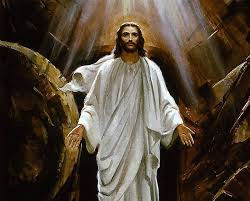
Jesus rose is a central tenet of the Christian faith found in the Apostles' Creed, affirming the physical resurrection of Jesus Christ. Based on Scripture, Jesus was crucified and buried, then resurrected on the third day, fulfilling prophecies and validating his deity.
Jesus repeatedly foretold that He would be raised on the third day (e.g., Matthew 16:21, Luke 24:7).
The phrase indicates a return to life, occurring on the third day after being buried on Friday (Good Friday).
.
It marks the triumph of life over death, demonstrating Jesus' power and completing his sacrifice.
According to first-century Jewish inclusive reckoning, any part of a day counted as a full day. Jesus died on Friday (Day 1), remained in the tomb on Saturday (Day 2), and rose on Sunday (Day 3).
In modern English, "again" often implies a second time, but in the context of the Creed, it translates the Latin resurrexit and Greek anastasis. It signifies a restoration—returning to the state of life he held before death—rather than a repeated event.
"According to the Scriptures": This theological detail (often paired with the phrase in the
Nicene Creed) suggests that the resurrection fulfilled Old Testament typological patterns, such as:
Jonah: Being in the belly of the fish for three days and three nights.
Hosea 6:2: Prophesying that God would "raise us up on the third day".
Genesis Patterns: New life sprouting on the third day of creation.
He ascended into heaven,

According to Christian tradition, Jesus ascended bodily into heaven 40 days after his resurrection, witnessed by his disciples on the Mount of Olives. This event signifies the completion of his earthly ministry, his exaltation to God’s right hand, and the start of his reign over all things.
Recorded in Luke 24:51, Mark 16:19, and Acts 1:9-11, where a cloud hid him from sight.
It confirms his victory over sin and death, allowing him to intercede for humanity and prepare a place for believers.
Represents his transition from earthly ministry to heavenly, spiritual governance as King.
Angels promised the disciples that Jesus will return in the same manner he left.
Observed as the Feast of the Ascension, typically 40 days after Easter.
and is seated at the right hand of God the Father Almighty;

The act of "sitting" signifies that Jesus has finished the work of redemption he was sent to perform on earth.
The "right hand" is a symbolic biblical image representing the place of highest honor, power, and sovereignty.
It affirms that Jesus holds equal status to God the Father within the Godhead.
This is not just a future promise; it declares that Jesus is ruling now over all of creation.
Psalm 110:1: The most quoted Old Testament verse in the New Testament: "The Lord says to my Lord: 'Sit at my right hand'".
Hebrews 1:3: States that after making purification for sins, he sat down at the right hand of the Majesty on high.
Romans 8:34: Confirms he is at the right hand of God and is also interceding for believers.
from there He will come to judge the living and the dead.
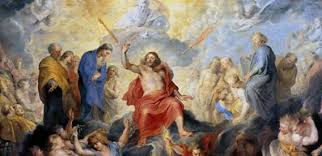
This phrase from the Apostles' Creed signifies that Jesus Christ, having ascended to heaven and sitting at the right hand of God, will return personally, visibly, and suddenly to earth to judge all humanity. The "living and the dead" includes those alive at his return and those resurrected.
A future, literal event, not merely a metaphor, marking the end of the current age.
Jesus will act as judge, a role given to him by the Father, to evaluate all people based on their deeds.
The living and the dead" refers to all humanity, with judgment determining eternal destiny.
This refers to the "right hand of God the Father," the place of supreme authority where Jesus is currently seated following his ascension.
This phrase encompasses the entire human race. The "living" refers to those physically alive on earth when Christ returns, while the "dead" refers to everyone who has already passed away but will be resurrected to face judgment.
Unlike his first coming to save, this return is for final judgment and establishing full, righteous authority.
A final, comprehensive judgment that separates the righteous from the unrighteous.
2 Timothy 4:1: "I give you this charge: Preach the word... in the presence of God and of Christ Jesus, who will judge the living and the dead".
Acts 10:42: Peter testifies that Jesus is "the one whom God appointed as judge of the living and the dead".
I believe in the Holy Spirit,

Believing in the Holy Spirit is a foundational Christian confession, affirming faith in the Third Person of the Trinity, who is worshipped alongside the Father and Son. The Spirit is recognized as the active, life-giving "helper" and "advocate" who indwells believers, inspires Scripture, fosters growth, and empowers service, acting as a guarantee of eternal life.
The Holy Spirit is God, co-equal with the Father and the Son.
The Spirit is experienced in creation, sustaining life, and as a source of comfort.
The Spirit convicts the world of sin, leads individuals to Christ, and prompts faith.
The Spirit enables believers to understand Scripture and produces fruits of righteousness—love, joy, peace, patience, kindness, goodness, faithfulness, gentleness, and self-control.
The Spirit acts as a guide, providing spiritual gifts for service and fostering unity.
Often called the Paraclete, he serves as a helper, guide, and source of peace during trials.
He has "spoken through the prophets" and continues to help believers understand the Scriptures today.
He produces virtues like love, joy, and peace (the Fruit of the Spirit) and empowers the church with various spiritual gifts for service.
the Holy Catholic Church,

The "holy catholic Church," as referenced in the Apostles' Creed, signifies the universal body of believers across all time and space, established by Jesus Christ, rather than just a single denomination. "Holy" denotes being set apart for God through Christ's sanctification, while "catholic" (from Greek katholikos) means universal, encompassing all Christians worldwide.
It transcends geographical boundaries, ethnicity, social class, and time, including both the living and the deceased.
The church is considered holy not because its members are perfect, but because it is consecrated by God, possesses the fullness of faith, and is guided by the Holy Spirit
.
It is viewed as the one, undivided body of Christ, often described as a, "communion of saints".
It is a single, unified body founded by Jesus Christ.
One: It is a single, unified body founded by Jesus Christ.
Holy: It is united with Christ, the source of holiness, and is sanctified by the Holy Spirit.
Catholic: Meaning "universal," it is intended for all humanity across all times and places.
Apostolic: It preserves the teachings of the apostles through a direct line of succession of bishops.
the communion of Saints,

The Communion of Saints is the spiritual union of all faithful Christians—living, deceased, and in heaven—forming one mystical body with Christ as the head. It signifies a shared bond in holy things (sacraments) and among holy persons (the Church). This doctrine highlights intercessory prayer and mutual support, affirming that believers, both in heaven and on earth, are united in a continuous, loving community that death cannot sever.
Church Militant: The faithful still living on earth, fighting against sin and striving for holiness.
Church Suffering (Penitent): The souls in Purgatory being purified before entering heaven.
Church Triumphant: The saints and angels in heaven who have attained eternal life.
A deep bond where the goodness and merits of one member are shared with others.
The saints in heaven pray for those on earth, and the living can ask for their intercession, akin to asking a friend to pray for them.
It provides reassurance that death is not the end of relationships and that the faithful are never truly alone.
It encompasses a shared communion in faith, sacraments, and charity.
Biblical Basis: Grounded in the concept of the "Body of Christ" (1 Cor 12), the "Cloud of Witnesses" (Heb 12:1), and the duty to pray for one another.
The Eucharist: The Holy Mass is seen as the primary, visible manifestation of this communion, uniting the earthly altar with the heavenly liturgy.
the forgiveness of sins,

In Christianity, the forgiveness of sins is the cancellation of spiritual debt and the removal of condemnation, made possible solely by God's grace through the sacrificial death and resurrection of Jesus Christ. It is received by faith, repentance, and confession, offering believers freedom from guilt, reconciliation with God, and eternal life.
Trusting that Jesus died for your sins and rose again.
A change of mind and turning away from sin toward God.
Admitting and confessing sins to God.
Accepting the gift of grace rather than trying to earn it
Removal of Guilt: Complete cleansing of past, present, and future sins.
.
Reconciliation: Restoration of a broken relationship with God.
Freedom: Living without the burden of spiritual condemnation.
Eternal Life: Receiving salvation and eternal life in Christ.
God, being holy, provided the only way for forgiveness through Jesus, who took the punishment deserved by humanity.
While God alone forgives sins, the church has the responsibility to proclaim this forgiveness and, according to some traditions, administer it through baptism and confession.
the resurrection of the body,
The resurrection of the body is a central Christian doctrine asserting that at the end of time, the souls of the dead will be reunited with their physically transformed, glorified bodies—modeled after Jesus Christ's resurrection. It signifies God's victory over death, the goodness of creation, and the ultimate restoration of human beings as composite body-soul creatures.
It is the belief that the same body that dies will be raised, but transformed into an imperishable, incorruptible, and spiritual, yet tangible body.
Grounded in the resurrection of Jesus as the "first fruits," with future resurrection promised for all, including a final judgment.
While many believe the soul goes to heaven immediately after death, the resurrection of the body represents the final, complete reunion of body and soul.
The resurrected body is described as glorified, powerful, and no longer subject to sickness, death, or weakness.
It affirms that physical existence is not evil (contrary to some ancient views) and that redemption includes the physical world, not just the spiritual.
and life everlasting.

"And life everlasting" is the final, hopeful phrase of the Apostles' Creed, representing the Christian belief in a resurrected, eternal existence with God. It signifies a, blissful,, perfected, and, unending,,,life, that, begins,,through, faith, and continues, beyond physical death. It is the,ultimate,,goal, of, salvation, and, the, fulfillment, of, God's,,promises,
It is not merely endless, time but rather, a, share, in, God's, own, life, free, from, death, pain, and, sin,.
The, phrase, directly, follows, "the, resurrection, of, the, body,", meaning, believers, will, experience, a,, glorified, body, similar, to, Jesus's, after, his, resurrection,.
While it is the, future, hope, after death, eternal, life, is, also, experienced, now, through, baptism, prayer, and, knowing, God,
It serves as the, conclusion, to, the, creed, (often, followed, by, "Amen"),,representing, the, final,,destination, of, the, faithful,
Amen.

"Amen" is an Abrahamic declaration of affirmation, originating from Hebrew and ancient Egyptian, meaning "so be it," "truth," or "verily".
It is used to conclude prayers, confirm faith in God's promises, and signal agreement. In the Bible, it appears as a closing response in the Old Testament and a formula for truth in the New Testament, notably used by Jesus to emphasize teachings.
It is used to affirm or agree with a prayer or blessing, meaning "So be it" (e.g., 1 Cor 14:16).
In the Old Testament, it acts as a, "Let it be so," such as in Numbers 5:22.
I believe in God,
the Father Almighty,
Creator of heaven and earth,
and in Jesus Christ, His only Son, our Lord,
who was conceived by the Holy Spirit,
born of the Virgin Mary,
suffered under Pontius Pilate,
was crucified, died and was buried;
He descended into hell;
on the third day He rose again from the dead;
He ascended into heaven,
and is seated at the right hand of God the Father Almighty;
from there He will come to judge the living and the dead.
I believe in the Holy Spirit,
the Holy Catholic Church,
the communion of Saints,
the forgiveness of sins,
the resurrection of the body,
and life everlasting.
Amen.
😊😊😊😊😊😊😊😊😊😊😊😊😊😊😊
😊😊😂😂😂😂😂😂😂😂😂😂😂😂😂😂😂😂😂😂😂😂😂
😂
😂
😂


Comments